Employers
Our Team
|
Vicki Newell
Executive Director
|
David Weeks
Data Manager
|
Bilingual Intake Specialist |
Program Assistant |
Research & Marketing |
Career Pathways Coordinator |
History
NNLC began in 1973 when one woman, Lola Jones, decided to help two Korean girls learn English. Soon, Jones’ efforts to teach adults how to read or speak English multiplied as volunteers Ester Early, Aurora Cortez, Clair Everson, Janet Frandsen, Lou Shaffer, Kathleen Olsen and Pat Zimmerman became certified in the Laubach method of teaching adult literacy in a one-on-one environment. For the next twenty years, these dedicated community activists recruited and trained other volunteer tutors and placed them with adult students. Tutors met one-on-one with their students for an hour each week in quiet corners of Washoe county libraries, coffee shops and book stores.
By the late ‘70’s, the group recognized that the growth in Washoe County’s population was creating a bigger demand for adult literacy services. They began to lay the foundation for the organization’s future and in 1983 filed for NNLC’s non-profit status. In the mid-‘80’s, the organization began receiving annual grants from Nevada’s Department of Education. These annual grants were federal funds appropriated through the U. S. Department of Education. With the 1993-94 grant of $25,000 came the need for increased accountability. How was the money being used? Exactly how many students were being served? How many of the students were advancing academically? In late ’93, NNLC’s Board of Directors recognized the need for full-time oversight and hired an Executive Director. At this point in time, NNLC was serving 47 adult students.
The release of the 1990 Census data and the National Adult Literacy Survey in early 1995 substantiated the need for NNLC to expand its role as an Adult Basic Education provider. Immigration was increasing, nearly a quarter of the adult population lacked a high school diploma or GED, and nearly 30% were functioning at the lowest two levels of literacy proficiency. It was evident NNLC needed to serve more students in a more aggressive manner. Changes were quickly implemented, as NNLC…
- moved from its one-on-one delivery method to classroom instruction, offering six hours of instruction every week in two levels of English as a Second Language Instruction (ESL);
- developed and implemented a student recruitment plan, concentrating its energies on the ESL (foreign-born) population, then expanding to the ABE (American-born) population;
- identified the life skills it needed to teach and developed a competency-based curriculum that would enable the students to master proficiency;
- redesigned its tutor training program to include more sophisticated teaching methods; and,
- began to develop working relationships with human service agencies in the community so they would refer clients who needed NNLC’s services.
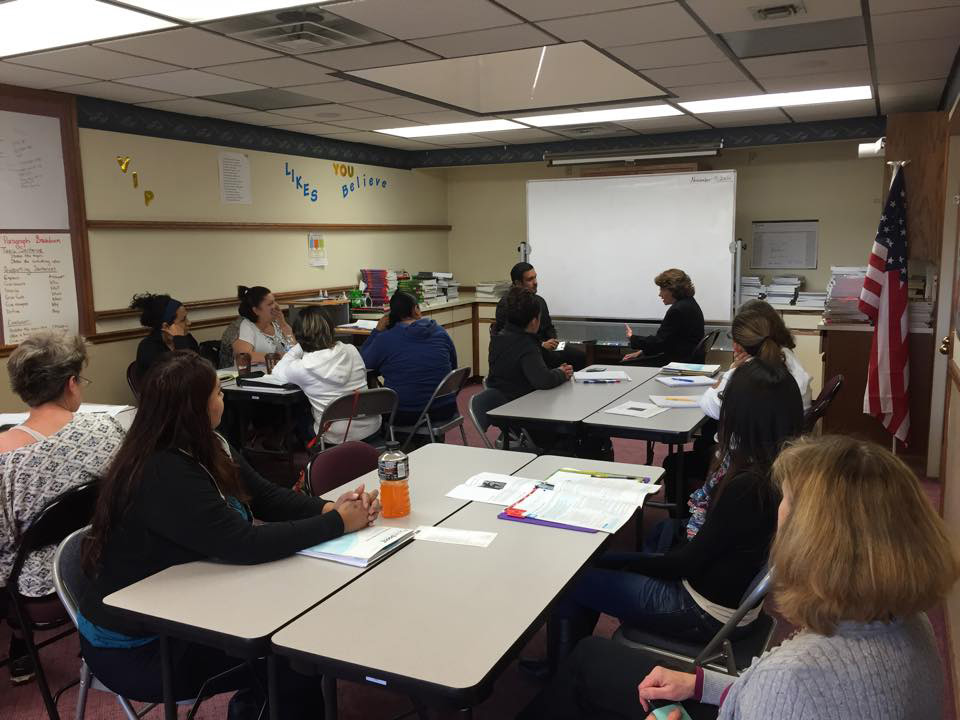
By the spring 1998, NNLC was bursting at the seams. Its services had expanded to four levels of ESL morning and evenings and a mixed-level ABE/GED class. It had also moved its Learning Center to the Greenbrae Office Center in Sparks and it was quite an honor when Sparks Mayor Tony Armstrong cut the ribbon at the grand opening attended by over 200 of NNLC’s friends and students. When the new fiscal year began in July 1998, NNLC, along with Nevada’s other Adult Basic Education programs, geared up for gigantic change – the WIA became law!
Commonly known as WIA, the Workforce Investment Act of 1998 combined job training and adult education into one piece of legislation so entities funded through it would work together to provide services to those in need. Adult Education services were spelled out in Title II of WIA – the Adult Education and Family Literacy Act. The Act specifies what adult education services an “AEFLA funded” program is to provide with intensity and duration (hours of instruction and duration of class sessions) and what performance measures and core outcomes a program is to strive to achieve. It calls for standardized assessments to measure student progress and mandates evidence or research-based curriculum are used in the delivery of instruction. Accountability was intensified and NNLC stepped to the plate to meet the law’s provisions. Accomplishments during the next 12 years include:
- Curriculum development – NNLC wrote and implemented the following:
- a two-level phonics-based ESL Pronunciation curriculum that became the subject of a research project through the Office of Program Evaluation at University Nevada – Reno to have it deemed evidence-based. The curriculum has since been used successfully by ESL teachers in seven foreign countries and the University of Ohio
- a three-level ESL life skills/employability skills competency-based curriculum written in such a manner lesson-by-lesson/step-by-step that NNLC's volunteer Instructors (quit calling them "tutors" when we went to classroom delivery) who worked another job all day could come in a 5:30 p.m., flip to a lesson and start teaching
- a 52-lesson Family Literacy curriculum based on 26 children's storybooks and used successfully with parents in elementary school Title I programs
- workplace-specific curriculum for golf course maintenance and landscaping made possible by a small grant from the Consortium on Adult Basic Education (COABE) and used successfully with employees at a local golf course and requested for use in two other states
- a 64-hour "Life Skills That Work" curriculum for use with special populations to increase their confidence in gaining/retaining employment – one program participant wrote, "Life Skills That Work" changed the way I value myself and now I know I can succeed."
- Program expansion – NNLC expanded its instructional offerings as follows:
- increased classes at its Adult Learning Center to five levels of ESL, one mixed level Adult Basic Skills class and three GED preparatory classes
- increased intensity and duration to each class providing 12 hours per week in 8-week class sessions
- established an 8-station computer lab and a 15-station computer lab to provide technology-based instruction as a supplement to classroom instruction
- equipped the Learning Center with a TTDY system and adaptive accommodations for students with visual and hearing impairments
- provided classes for parents at 21st Century schools, Title I schools, Family Resource Centers, churches, and recreation facilities
- provided work-specific programs at four resort properties, a linen manufacturer, an underground cable company, a championship golf course, and a roofing company
- participated as a host site for the Family Storyteller Family Literacy research project in collaboration with Washoe County Extension Service and University of Nevada – Reno, Department of Human Studies
- served as math study site for the Electrical Workers and Operating Engineers Apprenticeship programs
- served as host site and assisted with orientation presentations to potential employees for the Reno ReTRAC program the relocated the railroad tracks that run through downtown Reno
- competed a three-year contract with the Welfare Division, Nevada Department of Human Resource providing life skills classes to TANF clients in the Reno/Sparks area and five other Nevada communities
- Student activities – NNLC engaged its students in a variety of activities as follows:
- quarterly 16-hour Right and Responsibilities of Citizenship class
- participation in the Sparks chamber of Commerce "Salad and Solutions" event to increase their knowledge of the impact of public entity planning
- entered floats built and designed by the student in three annual City of Reno 4th of July parades
- adopted the Sparks Marina in a community service clean-up campaign for six months as a class project
- staged student body officer elections using voting machines donated by the Washoe County Election Department to develop the students' understanding of the election process. Students "filed" for office, selected a "campaign manager," "ran" for office, and those elected were inaugurated
In addition to this long list of accomplishments, NNLC has administered three successful Adult Basic Education State Leadership projects statewide:
- The Awareness Project - created awareness of the need for adult basic education programs. Armed with statistics, the project director traveled the state touting the virtues of adult basic education programs to County Commissions, Kiwanians, Chambers of Commerce, City Hall, Rotarians, politicos, and Soroptomists.
- Nevada Certified Literate Communities - addressed the literacy needs of a community at the local level. Guided by a Statewide Oversight Committee, which consisted of concerned professionals from private industry, economic development, libraries, corrections education, and human service agencies, the project provided Nevada communities with a framework to effectively identify local literacy needs, develop strategic plans, and establish local partnerships to provide support to literacy efforts.
- Nevada GED On-line – provided an alternative way to study and prepare oneself to take the official GED Test battery. GED On-line study centers were established in the computer labs at libraries and JobConnect offices statewide, bi-weekly enrollment events were held, and students who couldn’t, for various reasons, attend regular Adult Education classes now had access to an alternative.
The Nevada Certified Literate Community Project was recognized in December 2000 by the U. S. Department of Education as a “High Skills Community Concept.”
Over the years, various trends from U. S. Department of Education and Department of Labor have influenced the direction of Adult Education Programs. Most recently is the emphasis for Adult Basic Education Programs to provide Career Pathways programming. Once again, NNLC quickly accepted and adapted to the change restructuring its traditional life skills-based classes to focus on academics and workplace soft skills and implementing its “Plug Into Choices” program. Through all the changes and challenges, NNLC remains true to its mission: to provide responsive, quality educational opportunities that will enable our adult students to achieve their work, civic, family and personal goals.
Our Board Members
|
Sandra Borrelli
Chairperson
|
Patricia Miller
Vice Chair
|
Rochelle Dearborn
Secretary
|
Nancy Cummings
Treasurer
|
Jim Gerhard
Past Chairman
|